Peptide Quality Assurance & Pureness Screening Boc Sciences
We can give expert peptide pureness resolution services using logical reversed-phase HPLC coupled with mass spectrometry. Each peptide is carefully monitored throughout the analytical cycle according to strict analytical quality control and biosynthetic quality control criteria. HPLC is excellent at answering the concern "how pure Lyophilized Powder is this sample by chromatographic area percent? " It does not, by itself, prove that the primary optimal is the desired peptide.High pureness is preferable due to the fact that also tiny contaminants may hinder speculative results or interpretations. This short article will certainly break down exactly how peptide pureness is determined, why it stands out from peptide identification, what the common purity levels (95%, 98%, 99%) signify, and what "research-grade" implies in method for peptide reagents. Lots of peptide programs encounter logical uncertainty prior to they fail clinically. We make use of sophisticated reverse-phase HPLC to identify the pureness of customer peptide samples.
The Particular Technique: Reversed-phase Hplc
- At each step, there's a small chance that something goes wrong-- an amino acid doesn't attach, the incorrect modification happens, or a side response generates an unintended by-product.The dissolved peptide sample is infused into a stream of fluid solvent (the mobile phase) that flows via a tube loaded with tiny bits (the fixed phase).In accordance with ICH standards, confirmed techniques indicate the laboratory has actually developed the examination's accuracy, accuracy, discovery restrictions, and so on, ensuring the data you obtain are reliable.
The software application draws limits around each optimal and calculates the location beneath. The purity percent comes from contrasting the area of the major optimal to the total area of all identified heights. The majority of records consist of a table listing each top's retention time, area, and percentage of overall area.

Assistance
Explore our brochure to check out validated research study substances and find out more concerning our testing and quality control process. Even minor contaminations can change outcomes, minimize reproducibility, or introduce unwanted variables right into a research. Scientists depend on accurate, confirmed substances to ensure their findings are both legitimate and consistent.
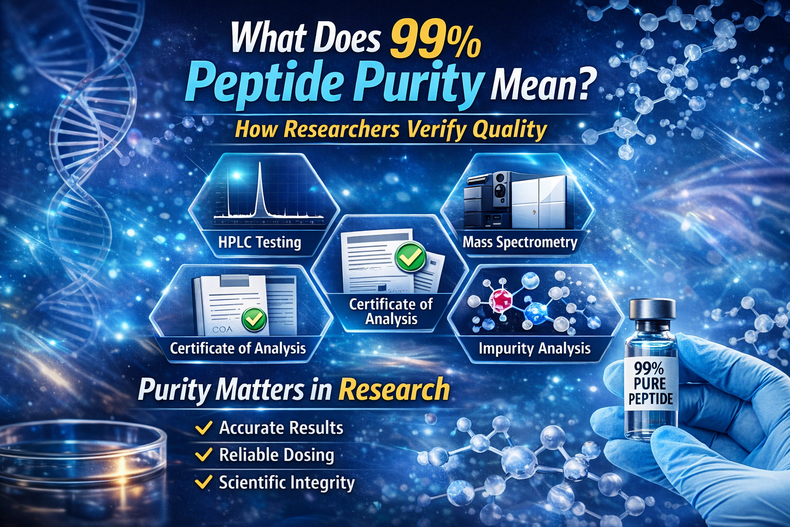
Imaginative Peptides recommends a series of various pureness degrees to assist you select the ideal peptide purity for peptide-based assays and applications. The following checklist shows the suggested peptide purity degrees needed for different peptide applications. Peptide recognition is largely done making use of mass spectrometry (MS), which offers precise measurements of peptide molecular weight. Additionally, techniques such as amino acid evaluation and HPLC are utilized to confirm the peptide's identification and pureness, guaranteeing precise characterization for different applications. We provide peptide identification verification using mass-based Thymosin Beta-4 methods chosen for the sample and logical purpose. This is very important when the major inquiry is whether the observed component matches the desired peptide or whether an alteration has been included as anticipated.
HPLC tells you what percentage of your example is the primary compound-- but it does not validate what that major compound in fact is. A height with the right retention time could in theory be a relevant peptide with similar hydrophobicity. Mass spectrometry gives identity confirmation by measuring molecular mass directly. We assess peptide size, series structure, anticipated molecular weight, adjustment kind, salt type, sample background, and desired downstream use before defining the analytical course. Trustworthy peptide testing labs will offer a suite of modern logical strategies-- HPLC paired with MS is a must, and availability of additional methods like capillary electrophoresis or amino acid analysis is a reward. Be careful of laboratories that do not use mass spectrometry alongside HPLC, as this could miss out on essential identification information. Similarly, stay clear of laboratories that can not demonstrate validated logical approaches. In accordance with ICH guidelines, verified approaches mean the lab has established the test's accuracy, precision, discovery limitations, and so on, making sure the information you obtain are reliable.